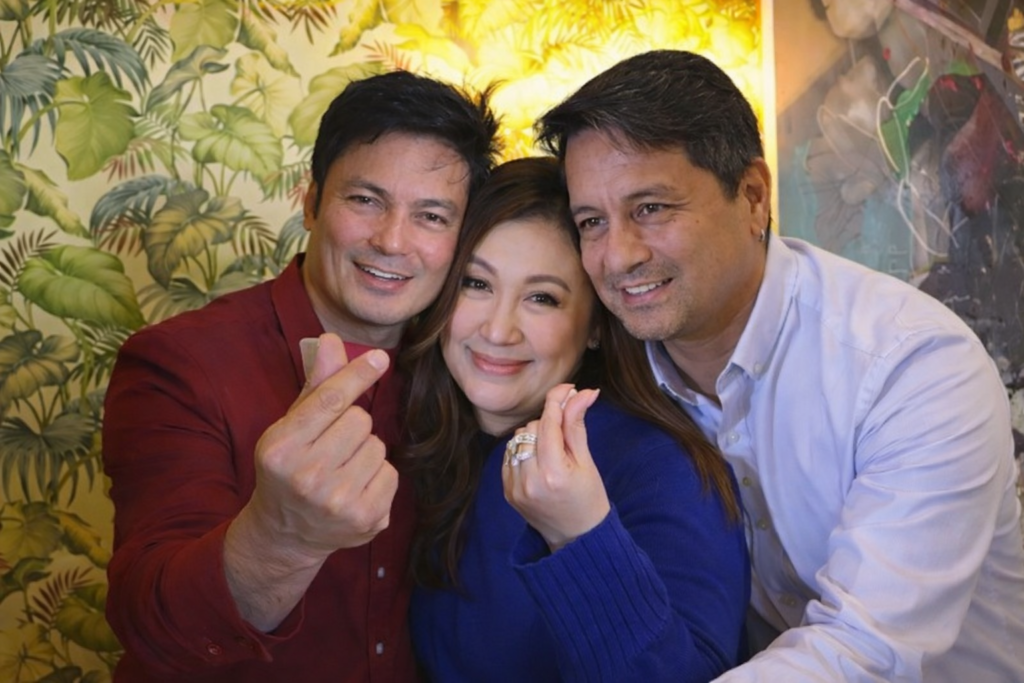
The quiet charm of Gabby Concepcion and Richard Gomez’s on-screen rivalry for Sharon Cuneta

A Philippine Television Love Story
Gab&Rich The quiet war for one woman’s heart
How Gabby Concepcion and Richard Gomez captivated a generation — and why their rivalry for Sharon Cuneta was the most irresistible drama Philippine screens ever produced.
Two men. One Megastar.
Explore the persona of each rival below.
Before the rivalry, there was a love story
Philippine television in the 1980s was a universe of outsized feeling. Melodrama ruled, and audiences gave themselves over to it completely — sitting in darkened living rooms, hearts in their throats, rooting for love to win. Into this world stepped Gabby Concepcion and Sharon Cuneta, two young stars whose chemistry was so natural it hardly seemed like performance at all. They were, for a time, the country’s sweethearts in the truest sense: a couple the nation felt it owned, whose happiness felt collective.
The pairing worked because it felt unforced. Gabby’s ease in front of the camera, his way of making Sharon laugh mid-scene, his unhurried tenderness — these were not things that could be directed. They were simply him. And Sharon, already the Megastar, seemed to glow differently beside him: younger, softer, more vulnerable than her superstardom usually allowed. Together they were not just a screen pair. They were a feeling — the feeling of being eighteen and certain the world was beginning.
“Their chemistry was so natural it hardly seemed like performance at all — two young people discovering the grammar of love in real time.”
Richard Gomez and the complication
Then came Richard. The arrival of Richard Gomez into the Sharon Cuneta orbit was, for Philippine popular culture, the moment a love triangle became mythology. Here was a man who operated in a completely different register from Gabby — darker, quieter, with the kind of cheekbones that suggested a life of romantic suffering. The public, which had been comfortably settled in its affection for the Gabby-Sharon pairing, was suddenly destabilized. Suddenly there were two visions of love on offer, and they were not interchangeable.
Gabby represented the familiar — the boyfriend-next-door, the summer romance, the love that is easy and warm and sun-lit. Richard represented something more complicated: desire with an edge, the lover who holds a little back, the man you have to work to understand. Philippine audiences, with their deep literacy in romantic feeling, understood immediately that they were being asked to choose between two fundamentally different philosophies of the heart. And they could not agree.
A rivalry written in chapters
Why it mattered — and still does
To dismiss this rivalry as mere celebrity gossip is to misunderstand what it represented. In a country where the romantic melodrama is a primary cultural form — where love stories carry the weight of national feeling — the Gabby-Richard rivalry was a genuine popular referendum on the nature of love itself. It asked, loudly and publicly, what qualities we prize in a partner, what version of romance we find most true.
The remarkable thing is that both men held their own. Neither was diminished by the comparison. Gabby’s supporters were not wrong about his warmth; Richard’s admirers were not wrong about his depth. Sharon, for her part, navigated the whole affair with a grace that only added to her legend — she was never simply a prize between two rivals, but a fully realized woman at the center of her own story, a professional at the height of her powers who happened to inspire extraordinary feeling in the men around her.
What this rivalry gave Philippine television was something rare: a love triangle without a villain. There was no one to root against. There was only the bittersweet pleasure of watching two beautiful, talented men orbit the same extraordinary woman, and the deeply human satisfaction of knowing that love — real love, on screen and off — is always more complicated and more interesting than we expect.
What remains after the curtain falls
Decades on, the rivalry between Gabby and Richard endures not because the question was ever answered — but precisely because it wasn’t. The unresolved quality of the rivalry is its power. Nostalgia, as the Filipinos understand better than most, is not simply longing for the past; it is the recognition that some stories deserve to remain open, to keep breathing, to invite each new generation to take sides and feel the old argument freshly.
Today’s audiences, discovering these films and television moments through streaming and social media, find themselves just as divided as their parents and grandparents were. The arguments in the comments sections have the same warmth, the same conviction, the same slightly performative outrage. This is the mark of a true cultural artifact: it does not age out of relevance. It simply changes its clothes.
Gabby Concepcion gave Philippine romance its most irresistible ideal: the boy who loves you easily, completely, without reservation. Richard Gomez gave it its most compelling counter-argument: the man who makes you earn the love, who holds something back, whose mystery is itself a kind of gift. Sharon Cuneta, luminous between them, gave it both — and in doing so, gave Philippine cinema one of its most enduring and treasured stories. Not a story that ended. A story that simply continued, quietly, in the hearts of everyone who ever watched and wondered, and chose a side, and never quite stopped wondering if they chose right.
“The unresolved quality of the rivalry is its power. Some stories deserve to remain open — to keep breathing, to invite each new generation to take sides and feel the old argument freshly.”