
Why Every Filipino Child Felt Seen When Bimby Aquino Got His First Paycheck

Why Every Filipino Child Felt Seen When Bimby Aquino Got His First Paycheck

When a video of Josh “Bimby” Aquino happily claiming his first “adult” salary went viral, most people smiled at the wholesomeness of it — a young man, barely out of adolescence, grinning at a wad of cash and immediately thinking of his mother. Sweet, yes. Heartwarming, certainly. But for millions of Filipinos watching, it was something far more layered than a celebrity feel-good moment. It was a mirror.
Because in the Philippines, what Bimby did is not remarkable. It is expected. And that distinction matters enormously.
The Unwritten Contract
There is a social contract that every Filipino child inherits at birth, written not in any document but in the marrow of the culture itself: your parents gave you life, raised you, sacrificed for you — and one day, when you have the means, you will pay it back. Not out of obligation in the cold, transactional sense. Out of something far deeper. Filipinos call it utang na loob — a debt of the inner self, a gratitude so profound it becomes a way of life.

The concept is widely acknowledged but rarely dissected. Utang na loob is often translated as “debt of gratitude,” but that translation is too thin. The word loob refers to the interior self — the core of one’s being. To carry an utang na loob is to acknowledge that another person has reached into your very soul and given something that can never be fully repaid. It is the recognition that you owe not money, not time, but a piece of your personhood.
A mother who stayed awake through fever-drenched nights. A father who skipped meals so the children could eat. Parents who shelved their own dreams so their children could have one. These are the debts Filipino children grow up understanding — not because their parents remind them loudly, but because the culture whispers it in every family dinner, every graduation speech, every prayer before a meal.

Bimby’s instinct to treat his mother with his first paycheck was not a calculated gesture. It was reflex. And that reflex is the utang na loob made flesh.
Children as Retirement Plans — and Why That’s Complicated
There is a less comfortable truth lurking beneath the warmth of Bimby’s story. In the Philippines, children are, practically speaking, the social security system. With no robust universal pension infrastructure and a majority of households living paycheck to paycheck, many Filipino parents raise their children with the quiet, unspoken understanding that their children will one day support them. It is not exploitation — it is survival architecture built across generations.
This manifests in countless Filipino households: the eldest child who defers college to work so younger siblings can study; the OFW who sends remittances home instead of building savings abroad; the young professional who rents a small room to send the bulk of their salary to the province. These are not extraordinary acts of sacrifice — they are Tuesday.
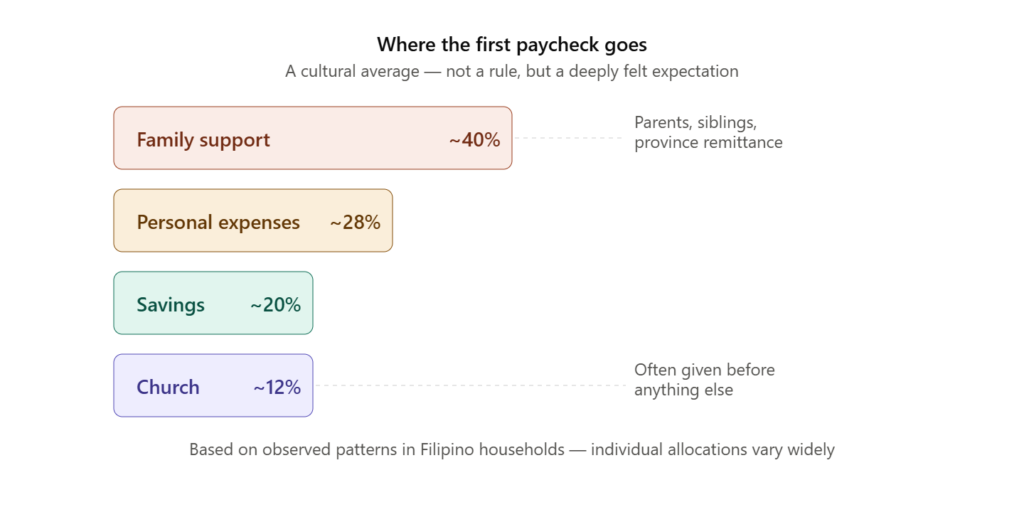
What Bimby’s story does not address — because it didn’t need to — is what this expectation costs. Young Filipinos today are navigating rising costs of living, mental health pressures, and the quiet grief of postponed personal milestones, all while carrying the financial and emotional weight of being a family’s pillar. The expectation is loving in origin but crushing in practice for many. The romanticization of filial piety — which viral moments like Bimby’s inadvertently contribute to — can sometimes make it harder for young Filipinos to draw boundaries or seek help when the weight becomes too heavy.
This is not a critique of Bimby. It is a reminder that for every child who can joyfully share a first paycheck with a parent, there are thousands for whom that first paycheck is not a celebration but a lifeline — for the whole family.
What Filipinos Were Really Reacting To
Comments sections across Facebook and Twitter filled quickly after the video spread. The reactions were predictable in the best way — which is to say, deeply Filipino.

“Napaluha ako nito,” wrote one commenter. “Ganito rin ang ginawa ng aking anak sa akin.” (I cried at this. My child did the same for me.)
Others were more wry about it: “Ang Pinoy, first sweldo pa lang, may listahan na ng bibigyan.” (Filipino first salary, and there’s already a list of people to give to.) The humor was affectionate, recognizing the communal nature of Filipino income — it is rarely just one person’s money.
Some drew comparisons to their own lives. A Twitter user recounted how she gave half her first BPO salary to her mother in 2019, keeping only enough for her commute. “At that time, I didn’t even think twice. Siyempre naman. Mom ko ‘yon.” (Of course. That’s my mom.) The Bimby story simply gave people permission to remember and share their own versions of it.
A few reactions pointed to Kris Aquino’s well-documented health struggles with autoimmune disease, noting that Bimby’s gesture carried an extra emotional register — that of a son who is watching his mother fight and choosing to show up in every way he can. That subtext was the quiet undercurrent of the entire video.

Faith, Family, and the Filipino Soul
Bimby’s decision to donate half his salary to the church before anything else adds yet another dimension. The Philippines is one of the most deeply Catholic nations on earth, and the act of giving the “first fruits” — offering the earliest portion of one’s earnings to God — is not merely religious practice. It is an expression of gratitude that reaches beyond family, acknowledging that blessings come from a source larger than any individual effort.
This triple act — giving to God, honoring mother, celebrating self — is a nearly perfect encapsulation of the Filipino value hierarchy. Community before self. Family before individual. Faith as the foundation of both.
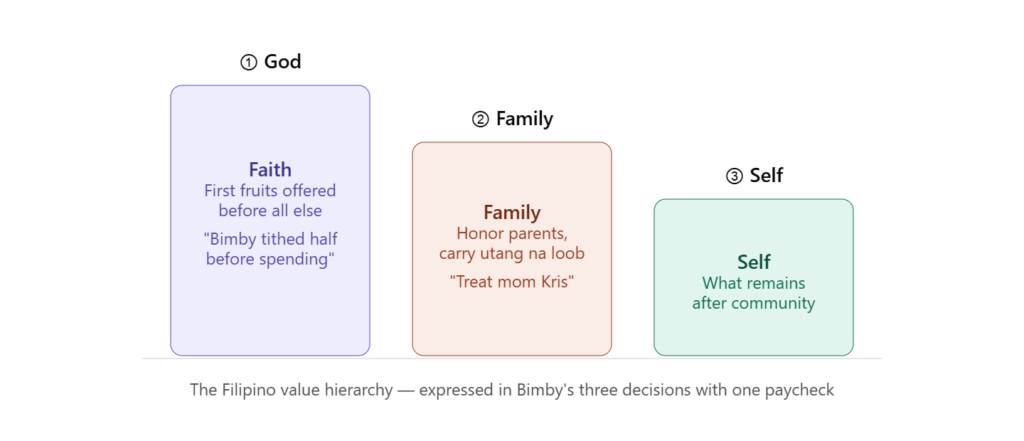
Bimby probably didn’t intend to say all of that with a single video. He was just a kid, happy about his cash, thinking about his mom. But that’s precisely why it resonated so deeply. It was unperformed. And in its simplicity, it told the story of an entire culture.
Handpicked for You